 Spacecraft Overview
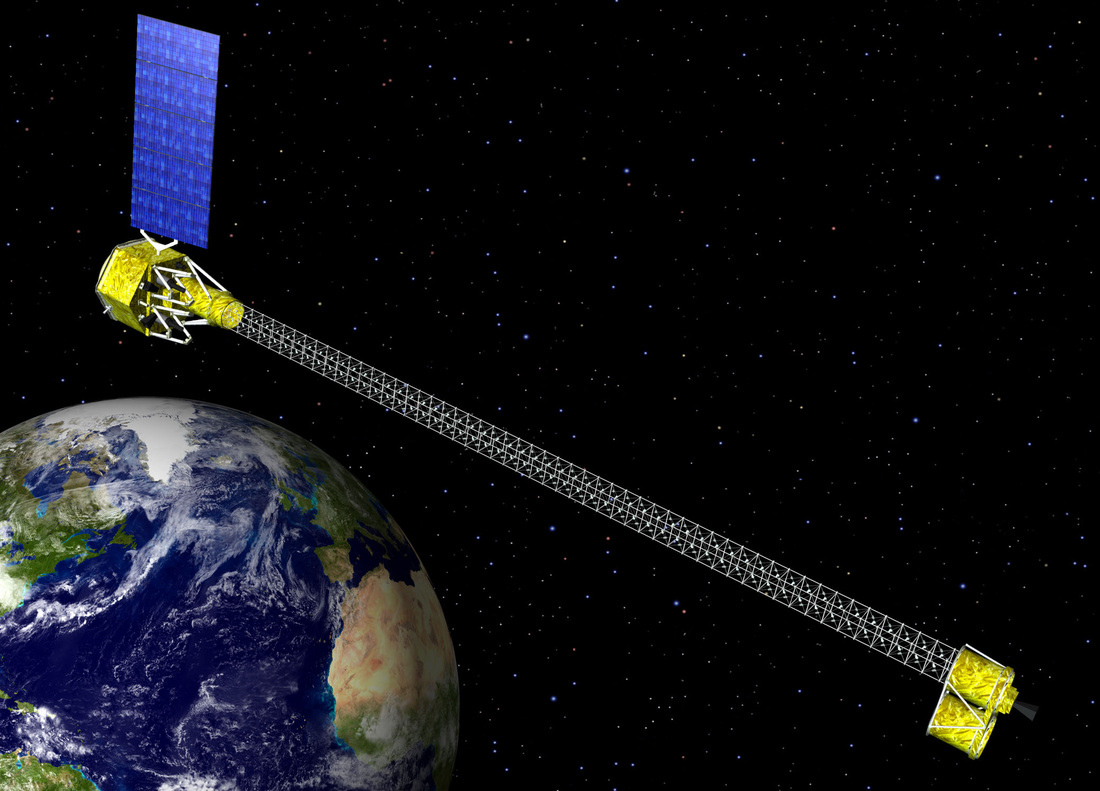
NuSTAR is a compact, light-weight spacecraft that utilizes flight-proven materials and new technologies in its instrument suite.
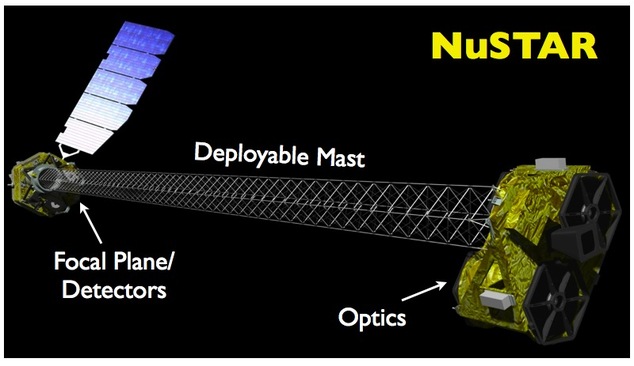
NuSTAR was designed and built by the Orbital Sciences Corporation. As a small Explorer Mission, the Vehicle was built around a low-cost mission design – forcing it to be compact at launch to fit on a low-budget launch vehicle, but still utilizing a nominal focal length of its telescope of 10.15 meters. To accommodate these two aspects, NuSTAR’s most important feature is a deployable mast which was designed and built by ATK Goleta. More on this particular system can be found on the NuSTAR Instrument Site.
The Spacecraft is based on the flight-proven LEOStar-2 Satellite design developed by Orbital. NuSTAR is the seventh satellite using this platform. NuSTAR has a liftoff mass of 365 Kilograms and will be less than two meters long and one meter in diameter inside the Pegasus Payload Fairing. NuSTAR has one deployable solar array. This single axis articulated array will provide 762 Watts of power for the Spacecraft and its instruments. The Vehicle is three-axis stabilized and utilized a Single String Design which is common for these small missions.
On-orbit design life is 25 months according to Orbital Sciences Corp., however Mission Personnel expect the Spacecraft to stay operational for up to 5 years, exceeding its primary mission of 24 months. The Spacecraft has a slew rate of 1.2 degrees per second and a settle time of 142 seconds.