• Home
  • Calendar
  • ISS
    • Expedition 36
    • Expedition 35
    • ISS Mission Archive
  • MSL
    • MSL Mission Updates 6
    • MSL Science Reports
    • MSL Rover Information
    • MSL Science Instruments
    • MSL Gallery
  • JUNO
    • Juno Mission Updates 2013
  • GRAIL
    • GRAIL Mission Updates
    • GRAIL Science Reports
  • NuSTAR
    • NuSTAR Mission Updates
  • RBSP
    • RBSP Mission Updates
  • IRIS
    • IRIS Mission Updates
    • IRIS Spacecraft and Instruments
    • IRIS Mission Design
    • IRIS Science Overview
  • Commercial
    • Arianespace>
      • Ariane 5
      • Soyuz Kourou
      • Vega
    • SpaceX
    • United Launch Alliance
    • Orbital Sciences
    • International Launch Services
    • Sea Launch Missions
    • CCDev
  • Russia
  • China
  • Japan
  • Entry
    • Re-Entry May 2013
  • Other
    • India
    • Launch Vehicle Library
    • Shuttle
    • Shuttle Retirement Updates 3
    • SLS Orion
    • NPP
    • Phobos Grunt
  • Search
  • About
Tweet
   

NuSTAR
Section

Picture

NuSTAR solves decade-old Problem of Black Hole Spin Rate Measurements

February 27, 2013

Picture
Image: NASA/JPL/Caltech
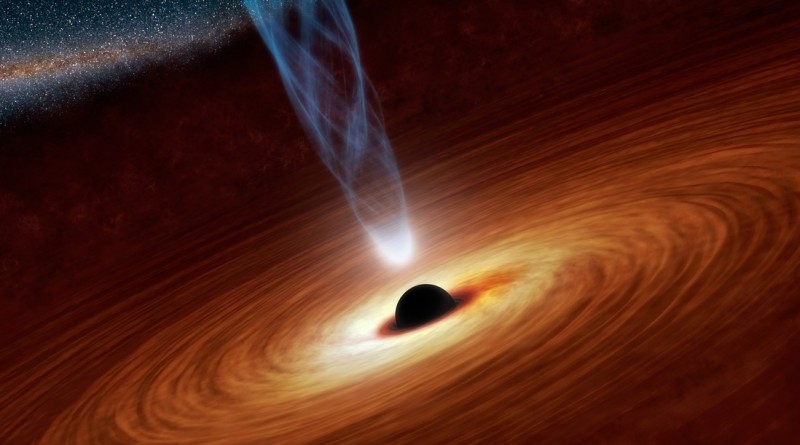
Black Hole - Event Horizon, Accretion Disk, X-Ray Source & Reflection
NASA's NuSTAR Spacecraft and the European XMM-Newton Space Observatory have, for the first time, conclusively measured the spin rate of supermassive black holes by first ruling out one of two conflicting models of black hole spin properties - a riddle that puzzled scientists for decades.

Supermassive black holes are objects that exhibit tremendous gravity which is capable of distorting space-time. The defining feature of a black hole its event horizon - a boundary in space-time through which matter and light can only pass inward towards the center of mass of the black hole. Not even light can escape from inside the event horizon, explaining the name "black hole."

Around the black hole, a so called accretion disk is formed. Matter moving toward the black hole due to its strong gravitational field forms a pancake-shaped disk-like structure that exhibits a spinning/spiraling motion due to conservation of angular momentum. 

Black holes are bright X-Ray sources because of the presence of an X-Ray binary that is caused by matter falling from one component (donor) to another (accretor). The accretor, in this case the black hole, is compact and causes the infalling matter to release gravitational potential energy as X-Rays. These X-Rays are then scattered and reflected in the accretion disk which allows the distance of the disk to the event horizon to be measured from which the spin rate of a black hole can be deduced. Emitted X-Ray radiation is examined by creating spectra of X-Ray brightness relative to the energy of the X-Rays.
Picture
Image: NASA/JPL/Caltech
The illustration above shows the basic model for determining the spin rates of black holes: In case of Retrograde Rotation, the accretion disk spins the opposite direction of the black hole. In this scenario, the accretion disk spins at a larger distance to the black hole's event horizon, which is illustrated by Einstein's theory of general relativity. The accretion disk can get closer to the black hole if the hole itself is not spinning at all. In the third scenario, the disk and the black hole are spinning in the same direction (Prograde Rotation) and the accretion disk can come very close to the event horizon. The faster a black hole spins, the closer its accretion disk can get to it which is another consequence of Einstein's theory of relativity. 

To deduce spin models and rates, scientists look at the X-Ray spectra that are reflected off the accretion disk to determine how close to the black hole it is located. In the three spectra shown above, a distinct peak can be found. This peak is located in the lower energy-range of the X-Ray spectrum and is radiation from iron atoms that are circulating in the accretion disk. The closer the accretion disk gets to the black hole, the more distorted the iron peak becomes.

The extent of iron peak distortion, a phenomenon called "red wing," reveals how close the accretion disk is to the black hole. Because this distance depends on the black hole's spin, the spin rate can then be determined. 

But prior to NuSTAR, there were two competing models that explained the distortion of the iron fingerprint in the spectra. The rotation model shown at the top of the image to the right held that the iron feature was being distorted by the immense gravity of the black hole. The second model, shown below, calls for the distortion being created by  obscuring gas clouds lying near a black hole. Because low energy X-Ray light such as that coming from iron is easily absorbed in matter, clouds in the vicinity of a black hole could cause the iron fingerprint to be distorted. In this scenario, the iron peak could not be used to determine the spin rate of a black hole because of incorrect data that is being measured.

Scientists have been trying to solve this case for decades, but X-Ray telescopes that were monitoring the lower region of the spectrum were unable to provide data required  to solve the problem. 
Picture
Image: NASA/JPL/Caltech
Picture
Image: NASA/JPL/Caltech
The graph in the image above shows the two theoretical models that explain low-energy X-Ray emission. The red line represents the gas cloud model while the green line represents the rotation model. The blue circles show the latest measurements made by XMM-Newton which can observe X-Rays from 0.1 to 10 Kiloelectronvolts. Data provided by XMM-Newton fits both theories equally well.

NuSTAR can measure high energy X-Rays of 3 to 79 keV. Its data is represented by the yellow dots which only fits the  Gravitational Distortion Model as X-Ray Brightness reaches another maximum in the higher-energy range of the spectrum, ruling out the Foreground Obscuration Model. 

Picture
Image: NASA/JPL/Caltech
"The results show that the iron feature, the sharp peak at left, is being affected black hole's immense gravity and not intervening clouds," NASA said in a statement. This also means that the red wing phenomenon can be used to determine the spin rate of supermassive black holes. "With the possibility of obscuring clouds ruled out, scientists can now use the distortions in the iron signature to measure the black hole's spin rate. The findings apply to several other black holes as well, removing the uncertainty in the previously measured spin rates," the statement said.

NuSTAR and XMM-Newton acquired this data by observing the black hole in the center of the  NGC 1365 galaxy. This particular black hole is 56 million light years from Earth and has two million times the mass of the sun. "These monsters, with masses from millions to billions of times that of the sun, are formed as small seeds in the early universe and grow by swallowing stars and gas in their host galaxies, merging with other giant black holes when galaxies collide, or both," said Guido Risaliti of the Harvard-Smithsonian Center for Astrophysics and the Italian National Institute for Astrophysics.


NuSTAR examines Black Holes & Supernova Remnants

January 8, 2013

NASA’s NuSTAR Spacecraft has provided imagery and data on two targets that the spacecraft targeted in late 2012. These targets were the spiral galaxy IC 342 (Caldwell 5) and Cassiopeia A, a Supernova remnant 11,000 light-years away from Earth.

"These new images showcase why NuSTAR is giving us an unprecedented look at the cosmos," said Lou Kaluzienski, NuSTAR program scientist. "With NuSTAR's greater sensitivity and imaging capability, we're getting a wealth of new information on a wide array of cosmic phenomena in the high-energy X-ray portion of the electromagnetic spectrum."
NASA’s NuSTAR Spacecraft has provided imagery and data on two targets that the spacecraft targeted in late 2012. These targets were the spiral galaxy IC 342 (Caldwell 5) and Cassiopeia A, a Supernova remnant 11,000 light-years away from Earth.

"These new images showcase why NuSTAR is giving us an unprecedented look at the cosmos," said Lou Kaluzienski, NuSTAR program scientist. "With NuSTAR's greater sensitivity and imaging capability, we're getting a wealth of new information on a wide array of cosmic phenomena in the high-energy X-ray portion of the electromagnetic spectrum."

IC 342, also known as Caldwell 5,is located on the constellation Camelopardalis (the Giraffe), 7 million light years from Earth. In the galaxy, previous X-Ray studies like Chandra have shown two very strong X-Ray sources that turned out to be two massive black holes, called ultraluminous X-ray sources (ULXs). NuSTAR has been designed to examine ULXs and resolve high-energy X-Ray targets in great detail. Scientists are investigating how ULXs can shine so brilliantly, but being relatively small sources in terms of mass.


These types of black holes are not as powerful as supermassive black holes at the center of galaxies, but they are still more than 10 times brighter than the black holes in our own galaxy.
Picture
Image: NASA/JPL-Caltech/DSS
Currently, astronomers think that ULXs are less common black holes of medium mass of several thousand sun masses, or stellar-mass black holes in an unusually bright state.

"High-energy X-rays hold a key to unlocking the mystery surrounding these objects," said Fiona Harrison, NuSTAR principal investigator. "Whether they are massive black holes, or there is new physics in how they feed, the answer is going to be fascinating."

In the image shown to the right, the two black holes appear in the color magenta with the two spots being entangled in the arms of the spiral galaxy. High-energy X-Ray appears magenta in the image, the rest is shown in visible light with the X-Ray data being superimposed on a visible light image. NuSTAR X-Ray data has been taken from 10 to 35 kiloelectron volts. Previous images of the galaxy have not shown the two black holes, as their maximum resolution only allowed them to be shown in a single pixel.

Chandra is capable of resolving these features, but the observatory only examines its targets in low-energy X-Ray. NuSTAR data can now be used to complement data already acquired by Chandra to investigate the mysterious properties of these black holes. Appearing much brighter than stellar black holes found in our own galaxy, the two targets in the image represent intermediate-mass black holes as opposed to supermassive black holes which would have sunk into the galaxy’s center. The exact reason for the extremely energetic state is the focus of ongoing studies.

IC 342 - NuSTAR Data Only

Picture
Image: NASA/JPL/Caltech
Picture
Image: NASA/JPL/Caltech
The second image released by the NuSTAR mission on Monday shows Cassiopeia A, a well-known Supernova remnant, in the constellation Cassiopeia.

"Cas A is the poster child for studying how massive stars explode and also provides us a clue to the origin of the high-energy particles, or cosmic rays, that we see here on Earth," said Brian Grefenstette of Caltech. "With NuSTAR, we can study where, as well as how, particles are accelerated to such ultra-relativistic energies in the remnant left behind by the supernova explosion."

In the image, the highest-energy X-Rays are shown in blue while green and red represent the lower energies observed in this area. X-ray light with energies between 10 and 20 kiloelectron volts are blue; X-rays of 8 to 10 kiloelectron volts are green; and X-rays of 4.5 to 5.5 kiloelectron volts are red. In the blue region, the shock wave from the supernova explosion is slamming into surrounding material, causing particles to be accelerated violently. During the acceleration, the particles emit synchroton radiation – a type of radiation that is released when charged particles are accelerated radially. Synchroton radiation can range over the entire electromagnetic spectrum. NuSTAR will determine the respective energies of the particles – something that has not been done before. This can enable scientists to explore what causes the particles to reach such great speeds.
In 2013, NuSTAR will continue science operations as well as fine-tuning of its instrument payload. The spacecraft will support targeted observations of chosen targets, coordinated campaigns with other observatories (both, space- and ground-based) and NuSTAR will continue to support black hole searches in the Milky Way Galaxy and the distant universe.

NuSTAR observes Flare of Black Hole in Milky Way Galaxy

October 24, 2012

Picture
Photo: NASA/JPL/Caltech
NASA’s NuSTAR (Nuclear Spectroscopic Telescope Array) Science Team has released the mission’s first official image and science data that was acquired when the spacecraft was examining a massive black hole in the center of the Milky Way Galaxy.

Between July 21 and 24, NuSTAR observed Sagittarius A*, the supermassive black hole located in the center of the Milky Way Galaxy. This was part of a multi-wavelength campaign. NuSTAR obtained high-energy X-Ray data on the target that is complementing coordinated infrared images obtained with the Keck telescopes, low-energy X-ray data obtained with Chandra, and very high-energy gamma-ray data obtained with the High-Energy Stereoscopic System (HESS).

Luckily for scientists, NuSTAR was pointing at Sgr A* when the black hole showed a flare that NuSTAR recorded in high-energy X-Ray. "We got lucky to have captured an outburst from the black hole during our observing campaign," said Fiona Harrison, NuSTAR principal investigator at the California Institute of Technology.
Picture
Photo: NASA/JPL/Caltech
"These data will help us better understand the gentle giant at the heart of our galaxy and why it sometimes flares up for a few hours and then returns to slumber."

Processes going on in Sgr A* are fairly uncertain as the black hole is different from black holes that are found in the centers of other galaxies. Those usually absorb stars and other matter located in the vicinity of the black holes, but Sgr A* is a very quiet Black Hole that does not absorb these quantities of matter. Understanding the processes that are going on in black holes and their growth are two fundamental questions that NuSTAR will help provide insight into. "Astronomers have long speculated that the black hole's snacking should produce copious hard X-rays, but NuSTAR is the first telescope with sufficient sensitivity to actually detect them," said NuSTAR team member Chuck Hailey of Columbia University in New York City.

The image shows a small white area which is the hottest material located closest to the black hole surrounded by a pink/violet blob which is hot gas that likely belongs to a nearby supernova remnant. The time series to the right shows the flare that NuSTAR observed with the middle image showing the peak of the flare during which the black hole was consuming and heating matter up to 100 million degrees Celsius. The image is composed of four bands of X-Ray energies: blue light represents energies of 10 to 30 keV, green is 7 to 10, and red is 3 to 7 keV.

NuSTAR celebrates first 100 Days & starts regular Observations

September 29, 2012

Picture
Image: NASA/JPL/Caltech
NuSTAR – now in orbit for more than 100 days, crossing that mark on September 21 – has entered regular science operations, making initial observations of black holes, super-dense dead stars and the glowing remains of exploded stars.

This early operations phase still features instrument characterization and the mission team is still in the process of optimizing NuSTAR Operations, making small tweaks and adjustments as they get to know their instrument better and better. Also, NuSTAR and other space-based observatories have continued coordinated operations of targets to increase science data return.
In mid-August, NuSTAR began looking at ‘Cas A’ a large Supernova remnant in the constellation Cassiopeia. Cas A is a very bright radiation source, but it is 11,000 light-years away in the Milky Way with the cloud of the material left from the Supernova being about 10 light-years across. The target is extremely faint, and only visible on long-exposure images. “NuSTAR's high energy X-ray image will trace the distribution of radioactive elements in this remnant, telling us about the explosive dynamics in the core of the supernova,” NuSTAR Principal Investigator Fiona Harrison wrote.
Over the course of August, the NuSTAR science team was still busy analyzing and interpreting the data acquired during instrument calibration so that science data could be properly processed and analyzed in order to understand the data NuSTAR is returning.
Until August 25, NuSTAR continued observations of Cas A before slewing to a new orientation in order to make a coordinated observation with the Chandra X-Ray Observatory of an ultraluminous infrared galaxy obtaining data to reveal whether a central black hole or star formation power these types of galaxies. Later in August, NuSTAR slewed back to watch Cas A.

For September, the science team planned sequences to have NuSTAR examine a starburst galaxy. These types of galaxies form a large amount of new stars at a relatively fast speed that, if sustained, would cause the gas reserves from which the stars are produced to run out in timescales that are much shorter than the age of the galaxy. As a result of this star formation, these galaxies are accompanied by a large number of neutron stars and black holes – X-Ray sources that NuSTAR can examine. NuSTAR tries to investigate the processes that trigger this rapid star formation and to determine the ratio of high to low mass star formation.

Also in September, NuSTAR positioned itself to look at Hercules X-1, a neutron star which are high-density objects if great mass that exhibit an intense magnetic field. “The huge magnetic fields create distortions in the spectrum (or rainbow) of X-rays that result, and NuSTAR will study this distorted spectrum to understand the physics taking place in these systems,” Harrison writes.

NuSTAR continues Calibrations, completes coordinated Observation

August 13, 2012

After taking its first light image in late June and continuing Spacecraft Commissioning Activities throughout the first half of July, NASA's NuSTAR Spacecraft has started science data acquisition, although calibration and software development tasks are still in progress.

Starting the month of July, NuSTAR performed a series of alignment measurements. For that, it pointed all over the sky, looking at different X-Ray Sources to check the alignment of spacecraft and telescope systems. The alignment was corrected and calibration activities continued.
On July 16, NuSTAR was part of an international campaign with several observatories observing a quasar.  NuSTAR and NASA's Chandra and Swift telescopes, together with INTEGRAL, Suzaku, and XMM-Newton observed the quasar 3C 273 simultaneously to provide data for cross-calibration that will be needed for future imaging campaigns. 3C 273 is an extremely bight high-energy source at a distance of about 2.4 billion light years. It is the first quasar to be identified and remains the optically brightest quasar in the sky. 

Picture
Image: NASA/JPL/Caltech
After the cross-calibration data acquisition was complete, NuSTAR stayed on this target for several more days to complete more refined measurements.  
"We're piecing together bits of the puzzle from this large suite of data, but we expect that the black hole itself is giving us information we can't capture with previous simple models. This is really amazing," NuSTAR's Principal Investigator Fiona Harrison wrote.

Between July 21 and 24, NuSTAR observed Sagittarius A*, the supermassive black hole located in the center of the Milky Way Galaxy. This was part of a multi-wavelength campaign. NuSTAR obtained high-energy X-Ray data on the target that is complementing coordinated infrared images obtained with the Keck telescopes, low-energy X-ray data obtained with Chandra, and very high-energy gamma-ray data obtained with the High-Energy Stereoscopic System (HESS). This data is used to examine the flickering of Sagittarius A* as it continuously grows by accreting matter. This will give astronomers insight in the extreme environments around black holes and the physics of black hole growth. 

Following that, NuSTAR resumed calibrations and small adjustments to improve data acquisition and spacecraft handling. Teams have been evaluating calibration and science data to understand how sensitive the telescope will be across the X-Ray spectrum. " It is clear we built really nice optics and detectors, and our current challenge is how do we accurately remove motion of the large 10-m structure and not blur the images. The ability is there but there is some software development to do," Harrison writes. To correct the images, the instantaneous position of the optics relative to the detectors is measured and all X-Rays that are recorded are being corrected to acquire a 'crisp image'. 


NuSTAR acquires First Light Image of Black Hole

June 29, 2012

After extending its Mast last week, NASA's NuSTAR Spacecraft has acquired its First Light Images after undergoing more Spacecraft Commissioning Procedures following Mast Deployment.
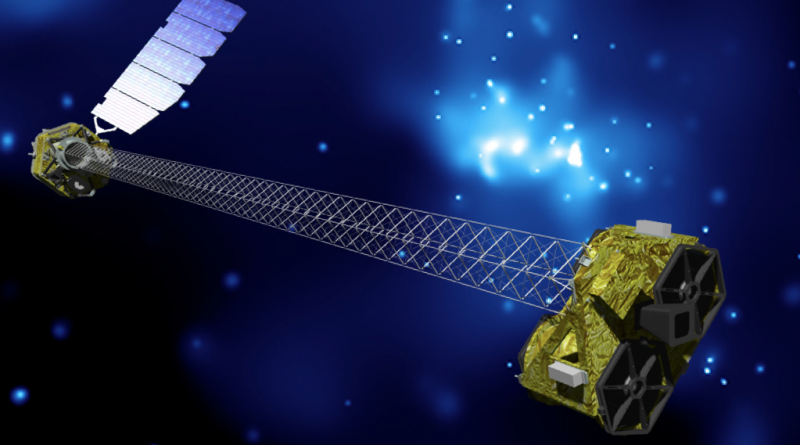
The Laser Metrology System was successfully aligned on June 23. NuSTAR includes a one-time Mast-Adjustment System to counteract even small misalignments of the System and ensures that images produced by NuSTAR are of the highest possible quality. This one-time optimization of the alignment of the optical axis was provided by a mechanism making two angular adjustments as well as rotation. To measure deflections of the mast, a system is in place that uses a laser metrology system that is comprised of two lasers that are mounted on the optics and point at three light-sensing detectors at the other end of the telescope. Measurements of the laser metrology system will be used to correct the X-Ray Images that would otherwise be blurred by the motion of the mast. Deflections are caused by thermal distortions when the spacecraft passes from Earth’s shadow into the sun-lit portion of its orbit or vice-versa. Also on June 23, the anticoincidence shields were turned on and verified, the CZT Detectors were activated on June 24. 

NuSTAR is equipped with two detector units, each at the focus of the Spacecraft’s two co-aligned optics units. The two optical units and detectors survey the same area of the sky and produce images that are combined on the ground as part of nominal data processing. The focal planes consist of four 32x32 pixel Cadmium-Zinc-Tellurium detectors. Each pixel is 600 micrometers in length. CZT detectors are room temperature semi-conductors that are very efficient at turning high-energy photons into electrons to visualize radiation. The electrons are digitally recorded by custom Application Specific Integrated Circuits that were specially designed for NuSTAR by Caltech.
On Thursday, June 28, 2012, the big moment was there; after years of designing and engineering, months of launch preparations and two weeks of commissioning in Orbit, NuSTAR opened its X-Ray Eyes and acquired its first light image.

Picture
Photo: NASA, JPL, Caltech
"Today, we obtained the first-ever focused images of the high-energy X-ray universe," said Fiona Harrison, the mission's principal investigator at the California Institute of Technology in Pasadena. "It's like putting on a new pair of glasses and seeing aspects of the world around us clearly for the first time." NuSTAR's first target was Cygnus X-1, a black hole in the Milky Way Galaxy that is siphoning gas off a giant-star companion. It is a very bright X-Ray target allowing the NuSTAR team to easily see where the telescope's focused X-rays are falling on the detectors for further evaluations and calibration operations. As part of the Spacecraft Commissioning Phase, NuSTAR will look at two more targets: G21.5-0.9 is the remnant of a supernova explosion that occurred several thousand years ago and is also located in the Milky Way; and 3C273 which is a quasar, located 2 billion light-years away in the constellation Virgo. It is one of the most luminous quasars known. NuSTAR will look at these targets to provide further calibration. Also, NASA's Swift and Chandra space telescopes, and the ESA's XMM-Newton Spacecraft, will look at 3C273 in coordination with NuSTAR to provide information needed for detector calibration. Once calibration is complete, the NuSTAR Spacecraft can begin its Science Mission. 
"We are going to open up the high-energy window on the universe," said Daniel Stern, project scientist for NuSTAR. "It's going to teach us a lot about the universe, from what heats the atmosphere of the sun to understanding black holes." The Spacecraft will take a census of collapsed stars and black holes in different areas and of different sizes. NuSTAR will make observations in our galaxy – the Milky Way – and deep observations of the extragalactic sky. Young recently-synthesized material in young supernova remnants will be of particular concern for the Mission and its science team – seeking to understand how stars explode and how they are created. Another element of NuSTAR’s examinations will be relativistic jets of particles from active galaxies that are hosting massive black holes. In addition to these science objectives, a broad range of science investigations like probing cosmic ray origins, studying physical properties of collapsed stars and studying the sun and its X-Ray emissions. Targets of opportunity are also part of the mission plan so that the spacecraft can respond to short-term events like supernovae and gamma-ray bursts. "We have planned observations of things we're safely sure we're going to see," Stern said, "but the big excitement is we might see things that are unexpected."
The vehicle will provide a combination of sensitivity, spatial and spectral resolution improved by factors of 10 to 100 over mission that have flown in previous years focused on X-Ray examinations. Science observations should pick up in mid July. "Some of the first things we'll be doing is looking at the center of the Milky Way at the Sagittarius A*, which is the black hole that resides in our own galaxy. Every once in a while it has hiccups, and that could be planets being swallowed. One of the first programs we have is to coordinate with Chandra and other observatories to watch what's happening with our own galactic black hole, also to survey the regions around that black hole to look for the remnants of previous stellar explosions, black holes, neutron stars, things that are left over after stars much more massive than the sun explode," said Fiona Harrison, NuSTAR principal investigator. 

NuSTAR successfully deploys its Mast

June 21, 2012

Picture
Photo: NASA/JPL/Caltech
_ The NuSTAR Spacecraft has completed the biggest Milestone of its On-Orbit Commissioning Phase when it deployed its mast on Thursday, June 21 to achieve the proper focal length needed to operate its optics.
The command to deploy the mast was sent to the vehicle at 17:43 GMT by Mission Controllers at UC Berkeley in California. Subsequently, the vehicle started the 26-minute deployment sequence to extend its 10-meter mast. Each of the 56 cube-shaped units was deployed – one by one – driven by a motor. The complex sequence was completed without any problems and spacecraft telemetry indicated that the mast was in place and secured. After deployment was confirmed, engineers and astronomers cheered celebrating this big milestone that was needed to enable NuSTAR to begin its science Mission and achieve its Mission Objectives.

_"It's a real pleasure to know that the mast, an accomplished feat of engineering, is now in its final position," said Yunjin Kim, the NuSTAR project manager at NASA's Jet Propulsion Laboratory, Pasadena, California. To ensure that the optics are precisely aligned, NuSTAR has the ability to make a one-time correction after mast deployment that will be performed over the coming days. This one-time optimization of the alignment of the optical axis is provided by a mechanism making two angular adjustments as well as rotation. To measure deflections of the mast, a system is in place that uses a laser metrology system that is comprised of two lasers that are mounted on the optics and point at three light-sensing detectors at the other end of the telescope. Measurements of the laser metrology system will be used to correct the X-Ray Images that would otherwise be blurred by the motion of the mast. Deflections are caused by thermal distortions when the spacecraft passes from Earth’s shadow into the sun-lit portion of its orbit or vice-versa. Also over the next several days, mission controllers will put the vehicle through attitude control profiles to verify the pointing and motion capabilities of the satellite. NuSTAR will take its ‘first light’ in about 5 days. These images are important for sensor calibration tasks that are also part of the Commissioning Phase.

NuSTAR Commissioning in Progress; First Spacecraft Glitch fixed

June 20, 2012

_ Following last week’s successful launch of NASA’s NuSTAR Spacecraft aboard a Pegasus XL Rocket that launched at 16:00 GMT on June 13, 2012, the vehicle has started on-orbit operations as part of its 23-day Checkout Phase.

NuSTAR is in a 615 by 633-Kilometer Orbit with an inclination of 6.02 degrees. The Orbital Period is 97.18 minutes. This Orbit matches the expected orbit required for NuSTAR to operate properly. After orbital insertion, NuSTAR deployed its Solar Array and switched to on-orbit operations mode communicating with the Tracking and Data Relay Satellite System and the Malindi Ground Station. NuSTAR entered a stable sun pointing mode as planned using its coarse sun sensors and reaction wheels. Sun pointing appeared to be nominal and the power system was working as expected keeping the batteries charged. 23Amps of current were provided by the Solar Array. Once initial checkouts were complete, the one-week spacecraft commissioning phase began. Shortly thereafter, teams ran into a minor problem with the vehicle. The reaction wheels started to spin faster than needed to maintain its proper orientation.
Picture
Photo: NASA/JPL/Caltech
__ A combination of reaction wheels and magnetic torque bars are used for spacecraft attitude control and stable pointing. Telemetry indicated off-nominal performance of the magnetic torque bars that are controlled by the vehicle’s flight computer. Engineers disabled the subsystem and the spacecraft was only using its reaction wheels for attitude control. The root cause of the problem was determined to be an improper calibration on the magnetometer and a phasing error with the torque bars. Both items were corrected and the system was re-integrated with the vehicle performing as planned after the fix.
Subsequently, spacecraft commissioning resumed with the activation of the instrument processors, heaters and laser metrology system which all showed nominal performance. The team has also been working with the spacecraft’s star trackers that are used for navigation, to get the systems fine-tuned for utilization during the science mission.
A major milestone that NuSTAR needs to pass before it can start using its X-Ray vision to map the Universe in high-energy X-Ray is the deployment of the mast to generate the required focal length of the optics suite. Mast Deployment is currently planned for Thursday, June 21. The deplyoment sequence has to be successful, otherwise, the mission could not meet any of its science objectives. The deployable mast was built by ATK-Goleta and is a low-weight and low risk component with significant flight heritage. It provides a stiff, stable and reliable structure on which the optics of NuSTAR are mounted. To ensure that the optics are precisely aligned, NuSTAR has the ability to make a one-time correction after mast deployment. At the beginning of the orbital mission, the telescope will be aligned before starting science data acquisition. This one-time optimization of the alignment of the optical axis is provided by a mechanism making two angular adjustments as well as rotation. To measure deflections of the mast, a system is in place that uses a laser metrology system that is comprised of two lasers that are mounted on the optics and point at three light-sensing detectors at the other end of the telescope. Measurements of the laser metrology system will be used to correct the X-Ray Images that would otherwise be blurred by the motion of the mast. Deflections are caused by thermal distortions when the spacecraft passes from Earth’s shadow into the sun-lit portion of its orbit or vice-versa.
_ One month after launch, the Spacecraft begins its primary mission that is expected to have a duration of at least two years. "We are going to open up the high-energy window on the universe," said Daniel Stern, project scientist for NuSTAR. "It's going to teach us a lot about the universe, from what heats the atmosphere of the sun to understanding black holes." The Spacecraft will take a census of collapsed stars and black holes in different areas and of different sizes. NuSTAR will make observations in our galaxy – the Milky Way – and deep observations of the extragalactic sky. Young recently-synthesized material in young supernova remnants will be of particular concern for the Mission and its science team – seeking to understand how stars explode and how they are created. Another element of NuSTAR’s examinations will be relativistic jets of particles from active galaxies that are hosting massive black holes.
Picture
Photo: NASA/JPL/Caltech
_In addition to these science objectives, a broad range of science investigations like probing cosmic ray origins, studying physical properties of collapsed stars and studying the sun and its X-Ray emissions. Targets of opportunity are also part of the mission plan so that the spacecraft can respond to short-term events like supernovae and gamma-ray bursts. "We have planned observations of things we're safely sure we're going to see," Stern said, "but the big excitement is we might see things that are unexpected." The vehicle will provide a combination of sensitivity, spatial and spectral resolution improved by factors of 10 to 100 over mission that have flown in previous years focused on X-Ray examinations. Science observations should pick up in mid July. "Some of the first things we'll be doing is looking at the center of the Milky Way at the Sagittarius A*, which is the black hole that resides in our own galaxy. Every once in a while it has hiccups, and that could be planets being swallowed. One of the first programs we have is to coordinate with Chandra and other observatories to watch what's happening with our own galactic black hole, also to survey the regions around that black hole to look for the remnants of previous stellar explosions, black holes, neutron stars, things that are left over after stars much more massive than the sun explode," said Fiona Harrison, NuSTAR principal investigator.

Pegasus XL delivers NuSTAR to Orbit after flawless Ascent

June 13, 2012

_ After months of delays, NASA’s Nuclear Spectroscopic Telescope Array (NuSTAR) has finally arrived in orbit - being launched on Wednesday by Orbital Sciences Corportation and NASA. An air-launched Pegasus XL Rocket was deployed from its carrier Aircraft at 16:00:36 GMT on June 13, 2012 and completed a nominal ascent placing the spacecraft on its planned trajectory. The launcher was deployed by the L-1011 Carrier Aircraft that took off from the Reagan Test Site at the Kwajalein Atoll in the Marshall Islands.
After all launch preparations were completed following the Ferry Flight from Vandenberg Air Force Base to Kwajalein last week, teams started countdown operations at 11:00 GMT on Wednesday, at T-4 Hours and 30 Minutes. Final pre-countdown operations included flight simulations and countdown rehearsals that were completed last weekend. Monday’s Launch Readiness Review gave the Green Light to press into the Launch Countdown. At the T-4:30-Mark, the Launch Team started their checklist to set the stage for vehicle power-up. Several polls were performed and the team received a weather briefing before the GO for Pegasus Activation was given. When the launcher was powered-up at around T-3:25, teams started extensive checkouts of the vehicle to make sure all systems were ready to support the mission. At T-3 Hours, the L-1011 Flight Crew boarded the ‘Stargazer’ Aircraft getting started on the Prestart Checklist right away while launch controllers were polled for L-1011 Engine Start. A GO was issued and the three Engines of Lockheed L-1011 TriStar were started. Inside the L-1011, launch team members were watching telemetry data coming from Pegasus throughout the remainder of the countdown. A minor receiver issue on NuSTAR caused the team to fall behind the timeline so that launch was pushed back 30 minutes to give teams enough time to complete pre-launch operations after the problem had been resolved by the spacecraft team. Wednesday’s launch window opened at 15:17 GMT and had a duration of 4 hours. The flight crew completed their Pre-Taxi Checklist by T-1:45 – also performing communication checks with launch control. 30 Minutes later, a GO for Taxi was given and the aircraft started moving a few minutes later getting ready for takeoff.
Picture
Pegasus Release ** File Image** Photo: Orbital
_All stations were polled for a GO/No GO for takeoff and teams confirmed that everything was ready for the mission. The carrier aircraft took of from Kwajalein at 15:00 GMT to begin launch operations. At the controls of the L-1011 aircraft were Pilot Bill Weaver and Co-Pilot Ebb Harris. Shortly after L-1011, a chase plane took off from the Reagan Test Site. While flying to the drop zone, the Pegasus Rocket was visually inspected by the chase plane making sure it was not harmed during takeoff.
Picture
Photo: NASA Kennedy
_15 Minutes prior to launch, the Pegasus Release Mechanism was armed. NuSTAR switched to internal power at T-15 Minutes placing the spacecraft in its final launch configuration. During the final countdown minutes, Pegasus and its Flight Termination System underwent final checkouts. A final weather verification was made and Range Controllers also validated that the drop zone was clear for launch. The final Launch Readiness Poll was performed which was the final verification ahead of launch. Pegasus XL was transferred to internal power as controllers continued to monitor the vehicle and its payload. Leading up to release, the Fin Batteries of Pegasus were activated and the fins of the rocket were put through a test profile. Arriving in the drop zone 217 Kilometers south of the Kwajalein Atoll, 6.75 degrees above the equator, flying at an altitude of 11.8 Kilometers, Co-Pilot Ebb Harris pressed the Release Button at the end of the terminal countdown. The Pegasus Launcher was dropped at precisely 16:00:36 GMT. After a 5-second drop, Pegasus ignited its first stage to start powered ascent.
_At that point, the launcher was 100 Meters below the L-1011 Aircraft. Providing 726 Kilonewtons of thrust, the Orion 50S XL Solid Rocket Motor consumed 15,014 Kilograms of propellants during its 68.6-second burn. Three seconds after ignition, the vehicle made a pitch maneuver to place itself on its exact trajectory. During first stage flight, the Rocket was controlled by its fin actuators that provided pitch control. The Orion 50S does not have Thrust Vector Control Capabilities. Burning out at T+1:17, the first stage was jettisoned 13 seconds later. At T+1:32, the Orion 50 XL second stage ignited at an altitude of 72 Kilometers. Making its 69.4-second burn, the second stage spent 3,925 Kilograms of propellants providing a total thrust of 196 Kilonewtons. 128 seconds into the flight, Pegasus separated its protective payload fairing after it had left the dense portion of Earth’s atmosphere. With NuSTAR exposed, the vehicle continued powered flight until the T+2:45-Mark when the second stage burned out. After burnout, the vehicle started a short coast phase. This allowed the stack to ascend to its apogee altitude. At T+9:29, the second stage was separated from the vehicle and the Orion 38 Solid Rocket Motor of the third stage ignited 11 seconds later when the vehicle was at an altitude of 621 Kilometers. Performing a 68.5-second burn with a total thrust level of 36 Kilonewtons, the third stage boosted the vehicle to orbit. Shutdown occurred at T+10:49. NuSTAR was deployed to its desired orbit at T+13:41, completing the Pegasus XL Mission. NuSTAR was released into a 626.9 by 632.8-Kilometer Orbit with an inclination of 6.024 degrees. Shortly after Spacecraft Separation, NuSTAR deployed its single solar array and established communications with the Tracking and Data Relay Satellite System confirming a successful orbital insertion.
_Now, NuSTAR is entering a 23-day on-orbit commissioning phase. This portion of the mission begins with basic vehicle checkouts and instrument activations as well as performance validation. Also in this phase, NuSTAR will deploy its Mast and teams will analyze the alignment of the Vehicle’s optical axis and plan the one-time adjustment. This operation is conducted to align the optical axis using a mechanism that is described on our Instrument Site. After the alignment, the Laser Metrology System will be calibrated and checked to prepare it for mission support. Additionally, the first month if the mission gives personnel on the ground the opportunity to familiarize themselves with actual mission operations, communication patterns and spacecraft control. One month after launch, the Spacecraft begins its primary mission that is expected to have a duration of at least two years. "We are going to open up the high-energy window on the universe," said Daniel Stern, project scientist for NuSTAR. "It's going to teach us a lot about the universe, from what heats the atmosphere of the sun to understanding black holes." The Spacecraft will take a census of collapsed stars and black holes in different areas and of different sizes. NuSTAR will make observations in our galaxy – the Milky Way – and deep observations of the extragalactic sky. Young recently-synthesized material in young supernova remnants will be of particular concern for the Mission and its science team – seeking to understand how stars explode and how they are created. Another element of NuSTAR’s examinations will be relativistic jets of particles from active galaxies that are hosting massive black holes. In addition to these science objectives, a broad range of science investigations like probing cosmic ray origins, studying physical properties of collapsed stars and studying the sun and its X-Ray emissions. Targets of opportunity are also part of the mission plan so that the spacecraft can respond to short-term events like supernovae and gamma-ray bursts. "We have planned observations of things we're safely sure we're going to see," Stern said, "but the big excitement is we might see things that are unexpected." The vehicle will provide a combination of sensitivity, spatial and spectral resolution improved by factors of 10 to 100 over mission that have flown in previous years focused on X-Ray examinations.
Picture
Image: NASA/JPL/Caltech
Picture
Image: NASA/JPL/Caltech
_Science observations should pick up in mid July. "Some of the first things we'll be doing is looking at the center of the Milky Way at the Sagittarius A*, which is the black hole that resides in our own galaxy. Every once in a while it has hiccups, and that could be planets being swallowed. One of the first programs we have is to coordinate with Chandra and other observatories to watch what's happening with our own galactic black hole, also to survey the regions around that black hole to look for the remnants of previous stellar explosions, black holes, neutron stars, things that are left over after stars much more massive than the sun explode," said Fiona Harrison, NuSTAR principal investigator. A full overview of NuSTAR’s Science Objectives can be found here. Also refer to our NuSTAR Spacecraft Information Site and Mission Profile Overview for more details about the NuSTAR Mission.

Launch Video


NuSTAR GO for Launch after clean Launch Readiness Review

June 12, 2012

_ Completing its Launch Readiness Review on Monday, NASA’s NuSTAR Spacecraft and Orbital Science’s Pegasus XL Launch Vehicle have passed the final review ahead of Launch Day. Managers granted the consensus to proceed with Launch Preparations and press into countdown operations after all systems of the Spacecraft, Launcher and Ground Support Facilities were discussed.
All preparations are on track for an on-time launch on Wednesday during a four hour launch window that opens at 15:16:49 GMT. The current launch target is 15:30:00 GMT leaving a total window open time of 3 hours, 46 minutes and 49 seconds. Meteorologists predict a 85% chance of favorable weather conditions during Wednesday’S Launch Window. Countdown operations will begin at T-4 Hours and 30 Minutes, visit our Countdown Timeline for more details. Setting the stage for launch, the L-1011 Aircraft controlled by Pilot Bill Weaver and Co-Pilot Ebb Harris, will take off from the Reagan Test Site at Kwajalein, Marshall Islands at T-1 Hour.

Picture
Photo: NASA/Orbital Sciences
_Once the plane with the Pegasus Launch Vehicle installed underneath is airborne, final checks of the rocket will be made. The Launch Team will be going through nominal launch operations including several polls marking countdown milestones. Once reaching the release position after the final GO for Launch is given, Harris will push the release button inside the Cockpit of the Stargazer Aircraft and the rocket will be dropped. Five seconds after release, when Pegasus has dropped to a distance of 100 meters from L-1011, the first Stage will ignite. The Orion 50S XL Rocket Motor will burn until T+1:17 consuming 15,014 Kilograms of Solid Propellant. During first stage flight, the Rocket is controlled by its fin actuators that provide pitch control. The Rocket’s Delta Wing provides some lift and supports a pitch maneuver that is initiated shortly after ignition. When the first stage has shut down at an altitude of 54.3 Kilometers, the vehicle will hold onto the stage for a few seconds before jettisoning the Rocket Motor at T+1:30. An instant later, the Orion 50XL second stage ignites and burns for 69.4 seconds burning 3,925 Kilograms of Propellants. Halfway through second stage flight, the payload fairing separates from the vehicle and falls into the ocean.

Ascent Ground Track

Picture
_ Attitude control is provided by Thrust Vector Control for Pitch and Yaw and Nitrogen Thrusters for Roll Control. At T+2:43, the second stage will have burned out placing the vehicle on a trajectory for a short coast phase. When the vehicle reaches apogee, the high point of its trajectory, the second stage is jettisoned at T+8:55 and the third stage begins a 68.5-second burn at T+9:06. After burnout of the Orion 38 Solid Rocket Motor that will consume 770 Kilograms of propellants, the vehicle will be in orbit. At T+13:14 seconds, the NuSTAR Spacecraft will be released into its desired Orbit of 575 by 600 Kilometers with an inclination of 6 degrees. This will mark the start of a three-week On-Orbit Commissioning Phase during which all Spacecraft Systems will be checked and reconfigured. The mast of the vehicle will be deployed over this period of time to provide the proper focal length between the optics suite and X-ray detectors on the main spacecraft platform setting up for the science mission that will have a duration of at least two years.
For more details, refer to our NuSTAR Resource Pages and the Launch Info Section.

NuSTAR arrives at Launch Site afer flawless Ferry Flight

June 7, 2012

In preparation for its upcoming Launch, NASA's NuSTAR Spacecraft completed its Ferry Flight from Vandenberg Air Force Base to the Kwajalein Atoll in the Marshall Islands.
The Pegasus XL Launch Vehicle was rolled out of its hangar at VAFB on June 2 and it was installed under the L-1011 'Stargazer' Aircraft. On June 3, the spacecraft underwent a Flight Readiness Test and the Launcher was checked as well. Setting sail for the Marshall Islands, the modified Jetliner departed Vandenberg on Tuesday and completed a 5-hour flight to Hickam Air Force Base in Hawaii for an overnight stop. the Ferry Flight was resumed on Wednesday and Orbital Sciences L-1011 carrier aircraft with the Pegasus XL rocket and the NuSTAR spacecraft arrived at the Kwajalein launch site in the Pacific Ocean at 1:45 p.m. Marshall Islands time on June 6. The ferry flight was flawless. The Launch Vehicle was powered up for the ferry operation and telemetry was monitored by engineers aboard the aircraft to make sure no systems were harmed during transportation. The L-1011 also flew through the launch-day "drop box" that included the racetrack pattern the aircraft will fly before Pegasus Release to give ground controllers the opportunity of verifying the communication links between the aircraft and Kwajalein. On June 9, the Launch Team will participate in a countdown dress rehearsal - the final pre-lauch simulation. The remains on schedule for June 13 during a 4-hour window opening at 15:30 GMT. June 14 and 15 have been reserved as backup launch slots.
Picture
Photo: NASA Kennedy
Photo Gallery: NuSTAR Installation on L-1011

NuSTAR is GO for Launch after clean Flight Readiness Review

June 2, 2012

The NuSTAR Flight Readiness Review was performed on Friday, June 1, 2012 and Mission Managers completed a thorough review of all Spacecraft and Launch Vehicle Systems. The meeting concluded with a decision to press into Ferry and Launch Operations setting the stage for NuSTAR's first launch opportunity on June 13 during a 4-hour launch window opening at 15:30 GMT. June 14 and 15 have been reserved as backup launch slots. On Saturday, the Pegasus Launcher is being rolled out of its processing hangar to the flight line for attachment to L-1011. On Sunday, all the final pre-ferry testing will be completed. Final checkouts will be performed and the Carrier Aircraft will depart Vandenberg for the Ferry Flight to Kwajalein on June 5. Arrival at the Reagan Test Site, Kwajalein Atoll, Marshall Islands, is set for June 6. Leading up to the launch, the Carrier Aircraft will be refueled and final close-outs and inspections will take place. On June 13, the vehicle will depart Kwajalein and fly to a pre-determined point from where Pegasus starts its Powered Ascent Phase to deliver NuSTAR to its desired low-inclination orbit.
>>>NuSTAR Launch Info
Picture
Photo: NASA Kennedy

Flight Readiness Review coming up; L-1011 at Vandenberg

May 31, 2012

Picture
Photo: NASA Kennedy
Photo Gallery: Payload Fairing Re-Installation
Preparing for the launch of NASA's NuSTAR Spacecraft (Nuclear Spectroscopic Telescope Array) in June, Teams at Vandenberg Air Force Base are nearing the completion of Pre-Launch Processing of both, the NuSTAR Spacecraft and the Pegasus XL Launch Vehicle. Late in May, the protective Payload Fairing was installed around the Spacecraft that remained in place on top of the Launch Vehicle during the launch delay of several weeks due to open work concerned with the launcher's flight computer. This flight will be the first mission of a new-generation flight computer of the Pegasus Rocket and teams needed to perform additional verifications that the unit issues correct commands during the ascent phase causing a three-month launch delay in March. While waiting for launch, testing between the NuSTAR Spacecraft and an additional Hawaii ground tracking station that will be used during the Pegasus XL flight have been completed successfully. Also, the spacecraft conducted a reaction wheel assembly spin procedure to exercise the reaction wheels and make sure the system was ready for the mission. In May, teams put the Pegasus through Launch and Ascent Simulations as well as a flight computer software evaluation providing good results.
The NuSTAR/Pegasus Flight Readiness Review will be conducted on Friday, June 1 and Mission Managers will discuss all systems of both vehicles and conduct a GO/No GO Poll for Launch Operations that are scheduled to pick up on Saturday. On May 24, Orbital Science's L-1011 Carrier Aircraft arrived at Vandenberg Air Force Base. On Saturday, the Pegasus Launcher will be rolled out of its processing hangar to the flight line for attachment to L-1011. Final checkouts will be completed and the Carrier Aircraft will depart Vandenberg for the Ferry Flight to Kwajalein on June 5. Arrival at the Reagan Test Site, Kwajalein Atoll, Marshall Islands, is set for June 6. Leading up to the launch, the Carrier Aircraft will be refueled and final close-outs and inspections will take place. On June 13, the vehicle will depart Kwajalein and fly to a pre-determined point from where Pegasus starts its Powered Ascent Phase to deliver NuSTAR to its desired low-inclination orbit.

NuSTAR set for Launch No Earlier Than June 13

May 7, 2012

Picture
Photo: NASA
_ NASA Teams and Managers at the Reagan Test Side at Kwajalein, NuSTAR’s Launch Site, have worked out a new ‘No-Earlier-Than’ Launch Date for the Pegasus XL Launch Vehicle set to deliver the NuSTAR Spacecraft to orbit. Launch is now planned to occur NET June 13, 2012 during a 4-hour launch window opening at 15:30 GMT.
The Pegasus XL Launcher remains inside the Processing Hangar at Vandenberg Air Force Base with its Payload Fairing removed and the NuSTAR Spacecraft exposed as final operations are underway to configure the vehicle for launch after all open items are being closed out at this time. Testing between the NuSTAR Spacecraft and the additional Hawaii ground tracking station that will be used during the Pegasus XL flight have been completed successfully. Also, the spacecraft conducted a reaction wheel assembly spin procedure to exercise the reaction wheels and make sure the system was ready for the mission. Adjustments to the Pegasus Flight Software are also being completed. Reviews of the Flight Computer that grounded the Pegasus XL Launch Vehicle in March are continuing.
_ This flight of Pegasus will be the first to use this particular computer and teams are looking to ensure that the flight computer and associated software issues correct commands during the ascent sequence. After the new software is loaded into the computers, teams will perform a Flight Simulation Test during which the computers are going through a full ascent profile and teams get a chance to assess the commands that are being sent by the system. After a thorough data review, teams will again press into Ferry Operations. The Payload Fairing will be re-attached later next week. The Rocket will be rolled out for installation under Orbital’s L-1011 Aircraft that will fly it to Kwajalein shortly before launch. There, final testing and preparations will take place to set the stage for launch. On Launch Day, the L-1011 will release the Pegasus XL Vehicle in a Pre-Programmed Position from where Pegasus starts its Powered Ascent Phase to deliver NuSTAR to its desired low-inclination orbit.

Payload Fairing removed for more Pre-Flight Tests

April 13, 2012

At Vandenberg Air Force Base, technicians removed the Payload Fairing of the Pegasus XL Launch Vehicle exposing the NuSTAR Spacecraft once again after the launch was delayed in March and is now expected to occur in June 2012.
The Payload Fairing has been detached to conduct another round of testing. The new launch date in June which is still being worked out by NASA and Managers of the Reagan Test Site's Range, requires a Tracking Station in Hawaii to provide Communication Support. Radio Frequencies have to be verified to make sure this backup site can support the Flight Termination System of the Pegasus Vehicle. To ensure there will be no problems with communications through that station, additional tests an verifications will be made. Also, engineers are still working on a Flight-Software Update to ensure the new-generation Flight Computer will work properly. Once the new software is loaded into the computer, another extensive period of launch vehicle testing will begin to ensure the computer is giving correct commands during powered flight. When all operations are complete, the Payload Fairing will be re-attached and the Rocket will be rolled out for installation under Orbital’s L-1011 Aircraft that will fly it to Kwajalein shortly before launch. On Launch Day, the L-1011 will release the Pegasus XL Vehicle in a Pre-Programmed Position from where Pegasus starts its Powered Ascent Phase to deliver NuSTAR to its desired low-inclination orbit.
Picture
Photo: NASA Kennedy
Photo Gallery: Payload Fairing Removal

NuSTAR targeting a June-Launch

April 3, 2012

Picture
Photo: NASA Kennedy
_ NASA has announced that the Launch of the NuSTAR Mission is now set for June from the Kwajalein Atoll in the Marshall Islands.
Reviews of the Flight Computer that grounded the Pegasus XL Launch Vehicle in March are continuing. This flight of Pegasus will be the first to use this particular computer and teams are looking to ensure that the flight computer and associated software issues correct commands during the ascent sequence. As teams continue to work on the Flight Software, the Spacecraft remains attached to the fully integrated launch vehicle inside a hangar at Vandenberg Air Force Base, California. Next week, technicians will remove the Payload Fairing of the launcher exposing the Spacecraft once again. A new round of Spacecraft Testing will get underway to make sure NuSTAR is ready for its mission. In addition to that, an updated version of the launcher’s flight software will be loaded into the Flight Computer. Afterwards, Mission Simulations will be repeated to confirm that correct commands are issued by the computer.
_When all operations are complete, the Payload Fairing will be re-attached and the Rocket will be rolled out for installation under Orbital’s L-1011 Aircraft that will fly it to Kwajalein shortly before launch. On Launch Day, the L-1011 will release the Pegasus XL Vehicle in a Pre-Programmed Position from where Pegasus starts its Powered Ascent Phase to deliver NuSTAR to its desired low-inclination orbit.
Currently, Mission Managers are working closely with the Reagan Test Site to set the new launch date. NASA aims to launch NuSTAR in the first week of June, however Range Availability at the Reagan Test Site dictates the scheduling process. A new launch date will be announced after the US Army clears a launch slot at the Test Site.

NuSTAR Launch delayed several Months

March 16, 2012

NASA’s Nuclear Spectroscopic Telescope Array or NuSTAR is facing a lengthy launch delay as Flight Software Checkouts and Range difficulties will keep the Spacecraft on the ground for an extended amount of time. The Flight Readiness Review was held on Thursday and Managers at Vandenberg Air Force Base, the Reagan Test Site and NASA’s Kennedy Space Center discussed spacecraft statuses and other items. A decision was made to postpone the mission to give technicians a chance to conduct more reviews of the new on-board computer of the Pegasus XL Launch Vehicle. This is done to verify that the new computer uses its Flight Software correctly to issue proper commands to the Launcher and Spacecraft during powered flight. Several Flight Simulations have already been conducted and data that was acquired during these operations is used to evaluate the computer. Additional tests involving the Rocket and the Spacecraft may be conducted should obtained data not be sufficient.
This launch delay moves NuSTAR’s earliest Launch Date out of its Launch Window meaning that the Range at the Kwajalein Atoll will no longer be available for the Flight.
Picture
Photo: NASA Kennedy
Photo Gallery: Pegasus Installation on Transporter
NuSTAR will now have to wait until another slot opens on the Range of the Ronald Reagan Ballistic Missile Defense Test Site in the Marshall Islands which is anticipated at some point over the next several months. NASA is now working with Range Managers at Kwajalein to find a new Launch Opportunity for the Mission as soon as possible after the vehicle has been cleared for flight.
Pegasus and NuSTAR will remain inside a hangar at Vandenberg Air Force Base until a new date is set. The Vehicle was placed on a transporter that will move it to the integration ramp where it will be attached to Orbital’s L-1011 Aircraft for the Ferry Flight to Kwajalein.


NuSTAR facing another Launch Delay

March 12, 2012

Picture
Photo: NASA Kennedy
Photo Gallery: Payload Fairing Installation
Photo Gallery: Final Launcher Closeouts

_NASA’s NuSTAR Mission is facing another Launch Delay as more time is required for data reviews associated with the Pegasus Rocket. The Flight Readiness Review that was originally planned to occur on Sunday has been pushed back to NET March 15 to give teams time for the reviews leading to another launch delay. These additional engineering data reviews are necessary because the Pegasus Launcher is equipped with a new Flight Computer. To ensure that the computer is giving correct commands during powered flight, data obtained during pre-flight simulations is being looked at by specialists. A new launch date has not been set at this time. It is expected that the final Launch Date will be issued after the Flight Readiness Review on Thursday.
Launch Preparations have been progressing as planned over the past week and teams have been performing final Launch Vehicle Close-outs over the course of the week. These operations were completed on Friday and the Rocket was placed on its carrier that will move it for integration beneath the L-1011 Carrier Aircraft. The installation was completed as expected and the next step is to transfer the vehicle to the runway ramp in order to attach it to the airplane as soon as a new launch date is set.


Payload Fairing installed, Ferry Preparations underway

March 5, 2012

_Over the past week, technicians at Vandenberg Air Force Base made final preparations for the Launch and Ferry Flight of the Pegasus Rocket and NuSTAR Spacecraft. Before Payload Fairing Operations got underway, Close-Out Procedures were conducted on both, the NuSTAR Spacecraft and the Payload Fairing of the Launch Vehicle, were performed to ensure all systems were properly configured for flight and no contamination was present. On Friday, the Payload Fairing Installation Process was started. It took two days to put the two halves of the Fairing in place on top of the Launch Vehicle. Installation operations were wrapped up on Saturday. Also over the weekend, a countdown simulation was completed that included the Launch Team and the Pegasus Vehicle to prepare all procedures that are needed on launch day. On Monday, Technicians are completing final Payload Fairing Securing in preparation for the ferry flight to the Launch Site. The L-1011 Aircraft that will fly the Pegasus Vehicle to the Kwajalein Atoll and eventually deploy the Rocket for its Mission will arrive at Vandenberg Air Force Base on Tuesday. The Launcher will be installed on the Aircraft and final pre-flight checks will be made before a GO for the ferry flight is given.
Launch remains targeted for No Earlier Than (NET) March 21 from the Kwajalein Atoll in the Marshall Islands aboard Orbital Science’s L-1011 Aircraft. Currently, no major problems are being worked.


Photo Gallery: NuSTAR Integration on Pegasus
Photo Gallery: Payload Fairing Installation

Picture
Photo: NASA Kennedy

Final Testing continues, Battery Charging underway

February 27, 2012

_Pre-Launch integration and ferry preparations are continuing for NASA’s NuSTAR Mission at Vandenberg Air Force Base, California.
After the Vehicle was installed on the Pegasus XL Rocket and all connections were made, the fourth Flight Simulation Test was conducted on February 21. This kind of test involves both, the Pegasus Vehicle and NuSTAR Payload, and puts the combined stack through a full duration ascent profile to evaluate the flight software and commands. The test was completed successfully and required data was obtained. Data reviews have been underway for the rest of the week to make sure all elements of flight commanding were executed correctly. The NuSTAR Mission Readiness Review was also conducted on Tuesday, Feb. 21 at the Jet Propulsion Laboratory, California. Mission Managers reviewed Vehicle and Mission Support Equipment statuses and reached a consensus to proceed with integrated mission and ferry preparations. On Wednesday, the Pegasus XL Launcher underwent GPS and IMU – Inertial Measurement Unit – pre-flight checkouts and performance verifications.

Picture
Photo: NASA
_To begin the new week, battery charging is underway on the NuSTAR Spacecraft and flight software updates are being installed on the Pegasus Launch Vehicle. These updates will be validated during upcoming tests. Preparations are on track and launch remains set for No Earlier Than March 21 from the Kwajalein Atoll and Orbital’s L-1011 Aircraft which will also perform the ferry flight to the Marshall Islands.

NuSTAR undergoing final Tests; Launch Date rescheduled

February 18, 2012

Picture
Photo: NASA Kennedy
Solar Array Deployment Test
Photo Gallery: Final Spacecraft Processing
Photo Gallery: NuSTAR - Final Tests

_Launch Preparations for NASA’s NuSTAR Mission are continuing at Vandenberg Air Force Base, California. The third Flight Simulation Test which puts the Pegasus Rocket and the NuSTAR Spacecraft with associated Software through a full duration Ascent Profile had to be postponed by one day to ensure Flight Software was configured properly. The Test was completed successfully on February 15 along with a checkout of the Rocket’s Range Safety System and Flight Termination Hardware. A final test of the Spacecraft’s Solar Array was performed on Thursday, February 16. For that, the single Solar Array was partially deployed. The Vehicle was placed in a tilt-rotation fixture and oriented to a horizontal position for attachment on the Pegasus Launcher. Payload Integration Procedures were in progress on Friday and will continue on Monday. Also this week, the Launch Vehicle Readiness Review was conducted by Mission and Vehicle Managers. A decision was made to reschedule the Launch of NuSTAR. The new ‘No Earlier Than’ Launch Date is March 21 to give teams an additional week to complete necessary engineering reviews before the Launcher makes its Ferry Flight to the Ronald Reagan Ballistic Missile Defense Test Site at the Pacific Ocean's Kwajalein Atoll aboard Orbital’s L-1011 carrier aircraft. The final steps of integrated processing at Vandenberg include more tests of the combined stack and the installation of the payload fairing.

Final Launch Preparations underway for NuSTAR and Pegasus

February 11, 2012

_The NuSTAR Spacecraft was shipped to Vandenberg Air Force Base for final pre-launch processing from the Orbital Corporation Facility in Dulles where the Spacecraft and its Instruments were integrated and pre-flight testing was completed. The cross-country move by truck started on January 25 and NuSTAR arrived in California on January 27. Over the weekend, technicians removed the shipping container and started checkout activities over the course of the first week in February. On February 1, a limited performance test of the NuSTAR Spacecraft was started and continued through Thursday. Also on February 2, a test of the Spacecraft’s Solar Array was conducted. For this test, the Solar Array was illuminated and power levels were monitored. Both tests were completed successfully and teams continued pre-launch processing with the attachment of NuSTAR to its Payload Adapter and Separation Interface. The operation was completed smoothly.
Meanwhile, the Pegasus launch vehicle was integrated at Vandenberg over the past several weeks and various pre-launch tests were completed. On January 25, a full launch simulation was completed with the Pegasus Rocket inside its Hangar at the Air Force Base. On February 2, the two halves of the Pegasus XL Payload Fairing arrived in California. Both halves were moved to a clean room where they were unpacked and processed for flight. Processing includes weighing both fairing halves in order to obtain their flight weight. The Fairing was cleaned and inspected to verify flight readiness. On February 8 and 9, an interface verification test was completed on the Pegasus Rocket. Required Data was acquired and a thorough review started on Friday and will continue next week. Minor discrepancies were noticed during the test but are not expected to delay the launch.
The NuSTAR Spacecraft will be installed on its Rocket next week and the Payload Fairing will be installed around the Payload. When final close-outs and tests are complete, the Vehicle will be flown from Vandenberg to its Launch Site, the Kwajalein Atoll, aboard Orbital’s L-1011 Stargazer Aircraft.


Picture
Photo: NASA Kennedy
Picture
Photo: NASA Kennedy
Picture
Photo. NASA Kennedy

© 2011-13 www.spaceflight101.com - Patrick Blau
Spaceflight101 content can be shared/reproduced for non-commercial or informational purposes. Appropriate crediting is appreciated.